
By. Areeba Amjad
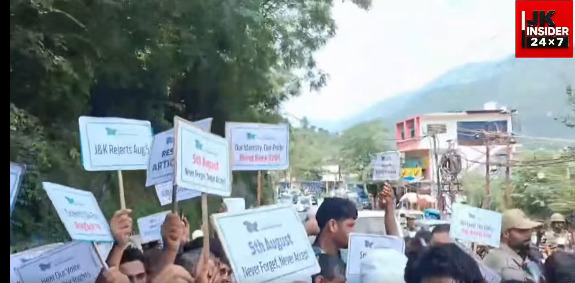
5th August 2019 is marked as a moment of action from New Delhi in revoking Article 370, hence leaving Kashmiris empty-handed from their own allocated special status. This is termed a complete violation of International Law and the UNSCR. The Constitutional and Administrative reforms resulted from this action, forcing away the special status of residents and their constitutional autonomy. This action, framed as a constitutional development, seems to be just an initiative to facilitate the BJP’s motives of prevailing Indian constitutional control and ultimately prioritising the Hindutva ideology. Besides all the motives, a thought-provoking question arises here: Did the constitutional and administrative transformations actually prove to be an initiative for equal rights for the citizens, or was it just a strategy for complete integration?
Within the time span of 7 years after this unfair treatment by the Indian government, the constitutional amendments were not merely transformations, but a complete restructuring of the governmental system. Sections 3 and 4 of the Jammu and Kashmir Reorganisation Act, 2019, formally declared two centrally administered Union Territories from Jammu and Kashmir, which ultimately opened the gates for complete Indian control disguised as reforms. In addition to that, domicile laws further added fuel to the fire by allowing illegal settlements. Over the course of time, Kashmiris lost their sense of sovereignty, primarily due to the Presidential Order C.O. 273. It ended up undermining the constitutional control of Jammu and Kashmir and promoting the Indian Constitution over the entire territory.
BJP prefers to call this equality of human rights. This narrative was constructed by the Indian government that these reforms would place Jammu and Kashmir in the same position like the other states of India. The transition in administration was supposed to prevail tourism, attract investments, and build Kashmir from within through industrial and infrastructure development. But in reality, it’s just creating a system for Kashmiris where they are merely losing their sense of identity. These constitutional reforms in the past 7 years have never been a step towards betterment, which apparently is not what New Delhi ought to promise.
Moreover, the administrative control of India took over the government, bureaucracy, and all the legal matters. Their executives are deployed consistently to deal with legal obligations. All the secretariat positions are allocated to the AGMUT cadre, leaving almost no administrative control in the hands of Kashmiris. Consequently, the legislative system first shifted towards a unicameral system under Article 57, which later on extended to such an extent that even ministers were turned down. J&K Reorganisation (Amendment) Act allowed this very own executive power to Indian administered officials. This is portrayed as a step towards bringing transparency to the executive system. But these 7 years have proved this as merely a strategy to slowly gain control over the executive positions and ultimately overtake the administrative system.
To this day, the Kashmiri citizens are still not able to digest this continuous mockery from New Delhi’s side. This could be seen in the recent elections of IIOJK, where the BJP managed to back only 29 seats. Kashmiris altogether are rejecting this administrative system, which is quite obvious from the results of these elections. However, the new assembly after these elections strongly condemned the revocation of Article 370. People of Jammu and Kashmir have elected the representatives so that the initial standard of Kashmiris could be restored. These elections showed their resilience against oppressive measures and hunger to recover their special status.
This brings us back to the initial question that was raised at the very start. The analysis and events within these 7 years have proved the fact that the reforms were strategized and that constitution and administration failed their test of bringing a revolution. It proved to be the mere change of laws only. These changing of laws resulted in a realization that the Indian government was never inclined towards bringing equality in Jammu and Kashmir region; rather they were focused on containing Kashmiris and exercise sheer power over them. Since the time of abrogation of article 370 to up until this day, India has only taken unfair measures and justified it in the name of human rights and equality. They appear to normalize the actions which are actually an illegal military occupation in order to make it seems like a natural phenomenon. Initiatives like bringing up the fact of hosting G20 summit (2023) in Kashmir and the discovery of 5.9 million tons of inferred lithium resources, where the numbers were heavily fabricated is a transactional psychological technique to introduce Kashmir as stable and peaceful under India’s constitution. Even the UN Special Rapporteur on Minority Issues, Fernand de Varenne termed it as India’s strategy. Their actions reflect that this whole agenda has always been a strategy to take over Kashmir which was their sole purpose since the time Kashmiris give majority of their inclination with Pakistan.
7 Years of continuous reforms did not actually result in a system facilitating Kashmiris. The sudden initiatives took in the name of bringing valuable structural reforms didn’t serve its purpose in real time. These ended up providing unprecedented control of vulnerable citizens under New Delhi. The conditions observed in these previous Years brought the revelation that the strategy was indeed to integrate Kashmir therefore the transformations afterwards were just crossroads to achieve this goal, masked up under the title of human rights resolution.
The Author Areeba Amjad is a research intern at YFK