
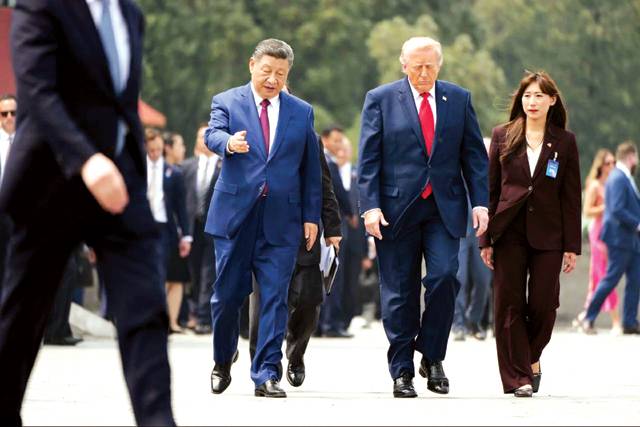
Beijing/Washington/Tehran – US President Donald Trump claimed on Thursday that Chinese President Xi Jinping offered China’s help to open the Strait of Hormuz and pledged not to send military equipment to aid Iran in its war against the US and Israel.
“He said he’s not going to give military equipment… he said that strongly,” Trump told the “Hannity” show on Fox News, after the two leaders met in Beijing.
“He’d like to see the Hormuz Strait open, and said ‘if I can be of any help whatsoever, I would like to help,’” Trump added.
Trump said that Chinese leader Xi Jinping offered during their talks Thursday to help resolve the conflict between the US and Iran. China has close ties to Iran and is the number one consumer of Iranian oil.
“President Xi would like to see a deal made. He would, he would like to see a deal made. And he did offer.
The US president had been widely expected to push China to pressure Iran to accept a peace deal and to open the Strait of Hormuz, a critical oil thoroughfare that has been largely shut down amid the war. A US readout of the meeting said that China agreed that the strait “must remain open” and that China is opposed to militarisation and a toll for the strait, points that largely align with China’s prior statements.
Secretary of State Marco Rubio said in a separate interview with NBC News Thursday that the US did not ask for China’s help and that “we don’t need their help.”
“We raised the issue to make clear what our position is and to make it clear so they understand, because it’s logical we would talk about it, given how dominant that issue is,” Rubio told NBC.
Chinese President Xi Jinping said Thursday that China’s development could go “hand-in-hand” with US President Donald Trump’s “make America great again” agenda, as both leaders met in Beijing for talks covering trade, Iran and broader global issues.
“Achieving the great rejuvenation of the Chinese nation and making America great again can totally go hand in hand, help each other succeed, and advance the well-being of the whole world,” Xi said at a banquet after the talks.
“We had extremely positive and productive conversations and meetings today with the Chinese delegation earlier,” Trump said, calling the banquet “another cherished opportunity to discuss among friends.”
Trump also said he had extended an invitation for Xi and his wife Peng Liyuan to visit the White House on September 24.
“It is my honor to extend an invitation to you, Madam Peng, to visit us at the White House this September 24, and we look forward to it,” he said.
The White House said both leaders agreed that the Strait of Hormuz “must remain open” to ensure the uninterrupted flow of global energy supplies.
Trump said the two countries would have “a fantastic future together,” while Xi said China and the United States “should be partners and not rivals.”
Xi was received with a formal red-carpet welcome at the Great Hall of the People, including military honors, a gun salute and schoolchildren chanting “Welcome!”
The visit marks the first by a US president to China in nearly a decade, taking place amid continuing tensions over trade, technology and global security.
Xi said stable ties between the two countries are important for the world, adding: “Cooperation benefits both sides, while confrontation harms both.”
He also told visiting US business executives that China would continue to expand its openness to international companies.
“China’s doors to the outside world will open wider and wider… American companies will enjoy even brighter prospects in China,” he said, according to Chinese state media.
Among US business leaders accompanying Trump were Nvidia CEO Jensen Huang and Tesla CEO Elon Musk. Musk described the meetings as “wonderful,” while Huang said the two leaders “were incredible.”
Iran was a key issue in the discussions after tensions in the Middle East delayed Trump’s visit earlier this year. Trump said he expected a “long talk” with Xi on Iran, which exports most of its sanctioned oil to China, but added: “I don’t think we need any help with Iran” from Beijing.
US Secretary of State Marco Rubio said Washington hoped China would take “a more active role” in the Persian Gulf region.
Trade and tariffs also featured prominently, with Trump seeking agreements on agriculture, aircraft and other sectors.
Before the visit, Trump said he would push for greater Chinese market access for US companies.
Both sides were also expected to discuss extending a one-year tariff truce agreed in South Korea last October after tariffs between the two countries rose above 100%.
China’s restrictions on rare-earth exports and growing competition in artificial intelligence were also part of the agenda.
Trump was also scheduled to visit Beijing’s historic Temple of Heaven as both governments sought to manage a tense but economically significant relationship.
Meanwhile, Iran’s Foreign Minister at the BRICS foreign ministers in India said that it should now be clear to everyone that Iran is undefeatable, and whenever it comes under pressure, it emerges stronger and more united than before.
Abbas Araghci who left Tehran for New Delhi to take part in the BRICS foreign ministers’ meeting delivered a speech, stressing that there were no military solution to Iran.
Just as Iran is fully prepared to fight with all its strength to defend its freedom and homeland, it is equally prepared to pursue and safeguard diplomacy, he stressed.
Araghchi pointed out to the fact that Iranians never bow to pressure or threats, but they respond positively to the language of respect.
The foreign minister called on BRICS member states and all responsible members of the international community to explicitly condemn violations of international law by the United States and Israel, including their aggression on Iranian territories.
BRICS member should prevent the politicisation of international institutions, take practical measures to stop warmongering, and end the impunity of those who violate the United Nations Charter, he concluded.