
NEW YORK – Pakistan called for an immediate and unconditional cessation of Houthi terrorist attacks against the Kingdom of Saudi Arabia.
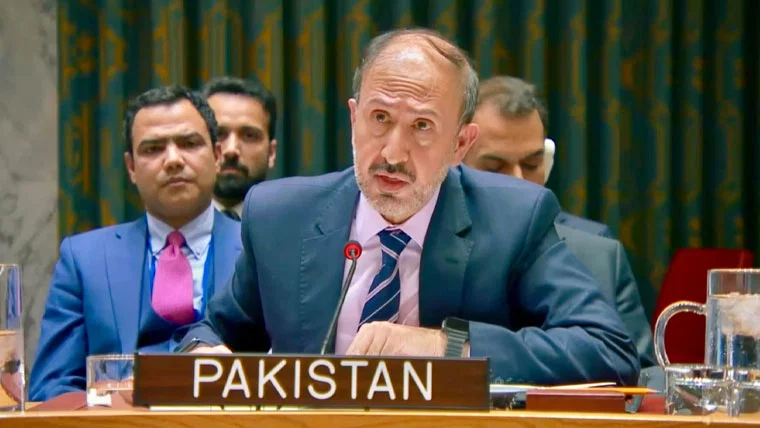
Pakistan’s UN Permanent Representative Syed Haider Shah highlighted the “grave security situation” in the region, according to a statement by the Permanent Mission of Pakistan to the United Nations posted on X on Friday. He condemned the continued Houthi attacks against Saudi Arabia and expressed Islamabad’s full solidarity with its leadership and people.
Statement by Ambassador Syed Haider Shah, Permanent Representative of Pakistan, At UN Security Council Meeting on the “Situation in the Gulf and its implications for international peace and security, in light of heightened tensions and threats to maritime security” (13 November 2026) ******** Madam President, I welcome the Secretary-General of the Gulf Cooperation Council to this meeting and thank him for the valuable briefing. His remarks underscore the deeply troubling implications of the current escalation on the security of the brotherly Gulf countries and the stability of the wider region. I also thank ASG Khalid Khiari for his insights. 2. The critical waterways of the region sustain international commerce and carry essential supplies of energy and other commodities. Heightened tensions and threats to maritime navigation in the region are a matter of serious concern. 3. Pakistan profoundly values its fraternal relations with the brotherly countries of the Gulf region, bound by faith, history and deep-rooted people-to-people ties. Their security and prosperity are of immense importance to Pakistan. 4.Allow me to emphasize following points: First, the sovereignty, territorial integrity and security of all regional States must be upheld. Pakistan unequivocally condemns all attacks against brotherly GCC countries and we stand in full solidarity with their Governments and peoples. We deeply appreciate their support for dialogue, diplomatic engagement, and pacific settlement of disputes. Second, Attacks against civilian objects including airports, energy installations and other civilian infrastructure are unacceptable. Pakistan condemns, in the strongest terms, the Houthi militia’s attacks and threats against the Kingdom of Saudi Arabia, including its civilian infrastructure and vessels engaged in lawful trade with the Kingdom. These actions endanger regional peace, undermine navigational freedoms and disrupt international commerce. We stand firmly and in complete solidarity with the Government and people of the brotherly Kingdom and reaffirm our unwavering support for its sovereignty, territorial integrity, security and prosperity. Third, maritime security is a shared international interest. Disruption of commercial shipping and attacks on merchant vessels both in Bab- Al Mandab and the Strait of Hormuz has underscored that crises at sea have grave implication for the continent and countries. These actions endanger seafarers, undermine navigational freedoms and jeopardize regional stability. The attacks and threats must end. The volatility at these maritime chokepoints have not only imperiled peace and stability but also skyrocketed energy prices and heighted fear of global food insecurity, disproportionately affecting vulnerable economies. Navigational rights and freedoms must be respected, commercial shipping protected, and humanitarian supplies must be allowed to reach those in need. The Strait of Hormuz is a critical maritime trade route for transit of one third of globally traded crude oil and significant share of global fertilizer trade. Its geostrategic location also makes it vital for region’s security and stability. Pakistan supports the restoration of normal passage, protection of vessels and crews, and safe, unimpeded commercial navigation. Fourth, for a lasting peace and security, the root causes and the drivers of conflict and instability in the region should be addressed. Ways must be found for building a regional framework of common security, peaceful co-existence and mutual prosperity and development. Fifth, dialogue and diplomacy must guide the way forward in the region. Pakistan’s own diplomatic endeavours reflect our conviction that lasting stability requires respect for sovereignty, civilian protection and negotiated solutions. All attacks must stop; communication channels should remain open; and regional initiatives and the Secretary-General’s good offices must receive sustained international support. Pakistan remains committed to continuing its own resolute efforts towards that end. Madam President, 5. The Council must unite to demand an end to all military provocations and unlawful attacks, protect civilians and commercial shipping, and advance peaceful solutions. 6. Pakistan will continue working with its brotherly and friendly countries and international partners to promote de-escalation, maritime security and lasting peace and stability in the region and beyond. I thank you.
— Permanent Mission of Pakistan to the UN (@PakistanUN_NY) November 14, 2026
The United Nations Security Council on Thursday renewed its sanctions regime on Yemen’s Houthi militia and moved to cut off supplies of dual-use components and precursor chemicals used by the Iran-aligned group to manufacture drones and missiles.
Unanimously adopted by consensus, the resolution strongly condemned the group’s renewed military escalation inside Yemen alongside its cross-border attacks on Saudi Arabia. It demanded that the Houthis immediately halt their domestic offensive, cease strikes against the Kingdom, and end threats to international commercial shipping.
Saudi-led coalition forces have said they intercepted suspected Houthi drones over Saudi Arabia’s Riyadh region and Eastern Province. Major General Turki al-Maliki, the spokesperson for the Saudi-led coalition, announced the interceptions of suspected Houthi drones on Thursday, in a statement carried by the Saudi Press Agency.
The Security Council extended a targeted asset freeze and travel ban on militia members until Nov. 14, 2027, and renewed the mandate for the UN Panel of Experts on Yemen, which monitors the sanctions, until Dec. 15, 2027. An arms embargo imposed on the Houthis under Resolution 2216 in April 2015 has no specified end date.
“Today’s adoption by consensus demonstrates this council’s determination to take decisive action against reckless attacks by the Houthis in Yemen and against the Kingdom of Saudi Arabia and the broader region,” said Sarah MacIntosh, the UK’s permanent representative to the UN. Britain is the Council’s penholder on Yemen, meaning it has primary responsibility for the Council’s activities on the issue.
“We stand in solidarity with the government of Yemen and the Kingdom of Saudi Arabia in the face of these attacks, and we reaffirm their right to defend their security and sovereignty in accordance with international law.”
The resolution aimed to address the growing capability of the militia to arm itself. MacIntosh said it ensured the sanctions regime “keeps pace with the evolving threat from the Houthis.”UN monitors have found that the militia maintains its arsenal through smuggling and by diverting commercially available parts. This has gradually made it less dependent on outside support and allowed it to produce attack drones locally.
The Council members called on “all parties to refrain from escalatory actions and to resolve differences and disputes through negotiation”, while also backing the territorial integrity of both Saudi Arabia and Yemen.
The resolution emphasized that measures taken for the purpose of maintaining sanctions “shall not apply to humanitarian assistance or supplies for basic needs of civilians, without negatively affecting legitimate trade activities”.
“The council sanctions are merely a means, not an end in themselves,” said Ambassador Fu Cong, China’s envoy to the UN, who hoped that “the situation in Yemen will de-escalate as soon as possible”.